









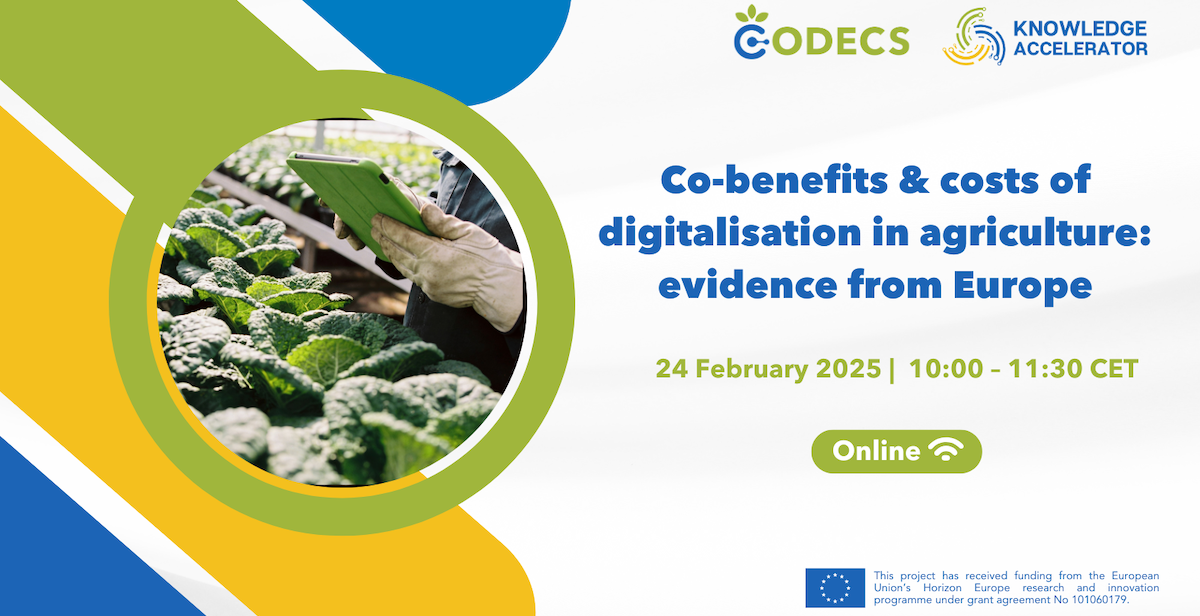
Date & Time: 24 February 2026 – 10:00 | 24 February 2026 – 11:30
Digital technologies are increasingly present on European farms, promising higher productivity, reduced environmental impacts and greater resilience. Yet digitalisation is not a one-size-fits-all solution. Its effects depend on farm size, production system, skills, support structures and local contexts. While digital tools can generate clear benefits, they also come with economic costs, organisational changes and new environmental and social challenges.
This webinar builds on CODECS report on Environmental, Economic, and Social Costs & Benefits of farm digitalisation to examine these realities in depth, combining farmers’ experiences with quantitative assessments of environmental impacts, farm-level economic analysis and social insights into work organisation and well-being.
Participants will discover how digitalisation can contribute to more efficient input use, improved planning and better working conditions; but also how investment costs, learning demands, data governance issues and constant connectivity can create pressure, uncertainty or exclusion for some farmers. Concrete examples will show how benefits and costs materialise in practice, and where trade-offs may arise between economic performance, environmental outcomes and social sustainability.
By bringing together research results and real-world experiences, the event aims to support more realistic, transparent and informed discussions around digital farming. In this context, the case studies will provide the main practical grounding for debate as key practical inputs have been developed. Ultimately, it seeks to contribute to policies and support mechanisms that help ensure digitalisation delivers value not only in technological terms, but also for farmers, rural communities and the environment.