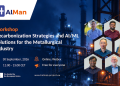
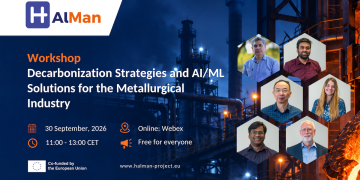




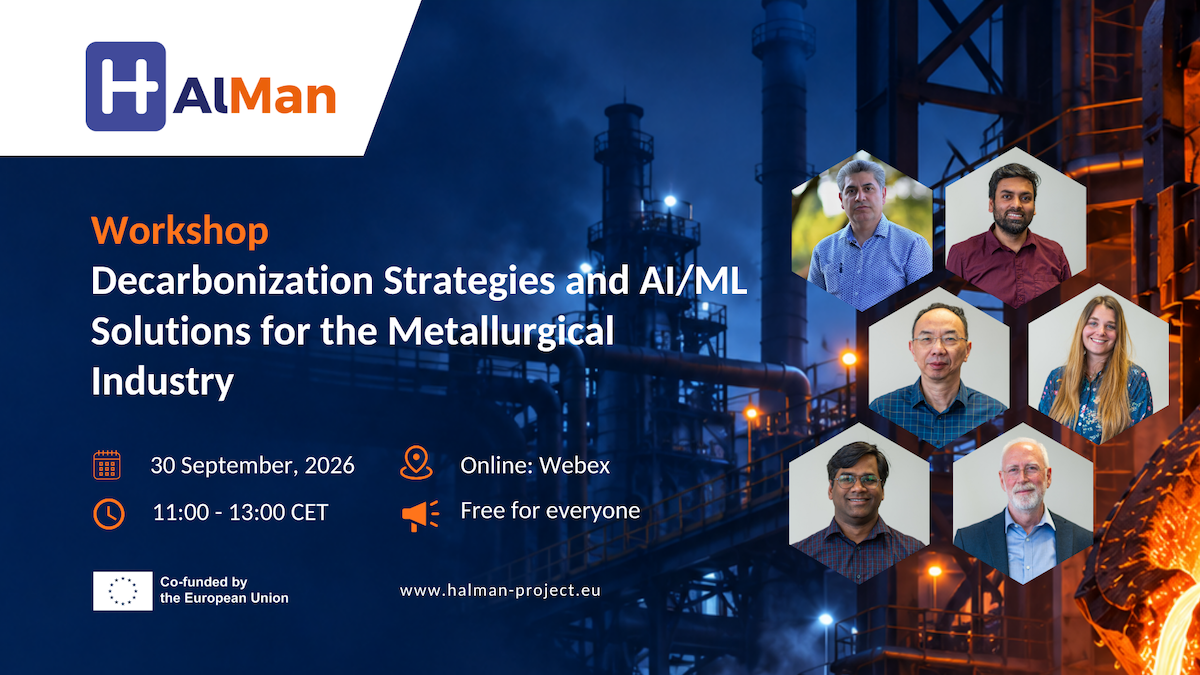
The HAlMan project invites researchers, industry professionals, technology providers and other interested participants to a free online workshop exploring how advanced process development and artificial intelligence can support the decarbonization of the metallurgical industry.
Taking place on 30 September 2026, the workshop will focus on innovative approaches to manganese pre-reduction and sustainable metals production. Experts from NTNU, NTUA, MET4 and SINTEF will present experimental research, physics-based modelling and state-of-the-art machine-learning solutions designed to improve process efficiency, reduce emissions and accelerate industrial decision-making.
The programme will cover hydrogen-based reduction of manganese ores, including the effects of ore characteristics, temperature, heating rate and operating conditions on reduction behaviour and kinetics. Participants will also learn how thermodynamic modelling and experimental process signals can support more reliable control of carbonation processes for alumina recovery.
Two presentations will demonstrate how metallurgical knowledge can be combined with AI and machine learning. Topics include kinetic and neural-network surrogate models, gradient boosting, Gaussian-process soft sensors and multi-objective optimization. The case studies will show how these methods can translate complex experimental results into practical operating recommendations for engineers.
Speakers include Prof. Jafar Safarian and Dr Alok Sarkar from the Norwegian University of Science and Technology (NTNU), Danai Marinos from the National Technical University of Athens (NTUA), Dr Michail Mavroforakis, CTO of MET4, and Kai Tang, Senior Research Scientist at SINTEF Industry.
The workshop is open to everyone and free of charge.
Date: 30 September 2026
Time: 11:00–13:00 CET
Format: Online via Webex
Participation fee: Free
Register for the HAlMan workshop
More information about the project is available on the HAlMan website.
HAlMan project ID 101091936 is co-funded by the European Union. Views and opinions expressed are however those of the author(s) only and do not necessarily reflect those of the European Union or HADEA. Neither the European Union nor the granting authority can be held responsible for them.