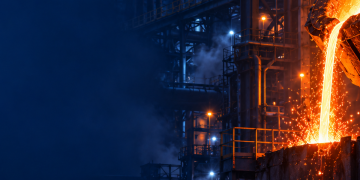









The EU co-funded project HAlMan is applying machine learning (ML), thermodynamic modelling and process optimization to improve metallurgical production. The aim is to help researchers and operators identify efficient operating conditions while balancing productivity, energy use and cost.
For hydrogen-based pre-reduction of manganese ores, ML models trained on 77 experiments can predict reduction times for different ore types. Multi-objective optimization then identifies practical trade-offs between faster processing and lower energy consumption, while interactive dashboards make these results easier to explore.
In the hydrometallurgical route, researchers have developed a soft sensor that estimates solution composition from routinely measured pH, conductivity and density. The system helps operators determine when to stop adding CO₂ during alumina recovery—before the desired product begins converting into unwanted dawsonite. The selected model achieved an R² of 0.9974 on held-out simulated compositions and reports confidence for each prediction.
By combining experimental evidence, chemical constraints, physical knowledge and data-driven models, HAlMan is developing practical decision-support tools for more efficient and sustainable metallurgical processing.
Read the full article on the HAlMan website
HAlMan project ID 101091936 is co-funded by the European Union. Views and opinions expressed are however those of the author(s) only and do not necessarily reflect those of the European Union or HADEA. Neither the European Union nor the granting authority can be held responsible for them.