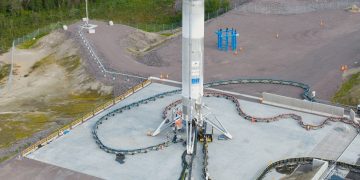








The Horizon Europe project CHEOPS VHP BB (Very High Power Hall Propulsion Building Blocks) has successfully concluded at the end of February 2026 after 30 months of collaborative research and development. The international consortium of seven European partners has delivered significant progress toward next-generation electric propulsion systems designed to support ambitious space missions, including exploration of the Moon and Mars, asteroid avoidance and mining missions, and in-orbit servicing operations.
The CHEOPS VHP BB project brought together leading industrial partners, research institutions, and SMEs from across Europe to develop key technological building blocks for very-high-power Hall effect thrusters (up to 20 kW). These advanced propulsion systems are expected to enable larger spacecraft, longer missions, and more sustainable space operations. The project also focused on developing advanced simulation tools and qualification methodologies to accelerate the deployment of such systems in future missions.
Vanessa Vial, Project Coordinator and Research and Development Programme Manager at Safran Spacecraft Propulsion, emphasized the broader impact of the project:
“Sustainability in space has become a strategic topic and a clear expectation from all stakeholders. Particular attention is on future constellations and collision-related risks due to the increasing number of satellites orbiting around the Earth. New solutions must be developed to optimize satellites’ life expectancy and remove existing space debris. This project is a chance for the future of the European space industry with the development of a 100% European-made solution capable of establishing Europe as a key player in the future space economy and environment.”
Key technological achievements
During the project, partners designed, developed and validated several critical components and methodologies for high-power Hall thruster systems.
One of the achievements was the development and preliminary qualification activities of a 100-ampere hollow cathode subsystem, a critical element for very-high-power electric propulsion. The cathode demonstrated reliable ignition and stable operation with multiple propellants, including xenon, krypton, and argon, and successfully completed thermal-vacuum, mechanical, and endurance testing campaigns. The subsystem endured a 1000-hour endurance test while maintaining stable performance and minimal wear.
The consortium also validated advanced additive manufacturing approaches for key propulsion components. Additively manufactured anode distributors for the TANDEM Hall thruster significantly reduced manufacturing time and cost, while decreasing component mass and weld count. This result demonstrates the potential of additive manufacturing to improve the industrial production of complex propulsion hardware.
Extensive high-power firing campaigns were conducted in large vacuum facilities to validate system performance and integration. The TANDEM nested Hall thruster and the Safran PPS®20k thruster were successfully operated at power levels up to 20 kW using different propellants. These campaigns demonstrated stable multi-propellant operation and produced valuable performance data, with thrust levels exceeding 1 Newton and efficiencies levels greater than 60%
Advanced diagnostic tools developed within the project enabled detailed analysis of thruster plumes, plasma behaviour and thermal performance. New measurement systems allowed precise mapping of ion current density and energy distributions, providing essential data for future design improvements and lifetime predictions.
Understanding thruster lifetime and reliability
This activity addressed the fundamental question of lifetime qualification for future, highly capable electric propulsion devices. The limits of current practice have been recognised, where the endurance demonstration is established on the lifetest of a single unit, with an arbitrary margin of 33% (or qualification factor of 1.5).
Because of the power and propellant consumption requirements, as well as sheer cost and duration of long-duration lifetests, it is recognized that future and sustainable lifetime qualification approaches will have to rely on a more rigorous approach combining life testing and modelling. As an illustration of the proposed way forward, a probabilistic failure analysis of selected wear processes was established in the framework of this project.
Another important contribution of the project was the study of plasma-wall interactions and erosion processes inside Hall thrusters, which are key factors determining thruster lifetime. Researchers investigated ion flux and energy at the thruster channel walls under different operating conditions. The results showed that, for all the tested operating regimes, ion energies remain below the sputtering threshold of the ceramic channel material through most of the plasma discharge chamber, offering valuable insights for extending thruster operational lifetimes.
Strengthening Europe’s space propulsion capabilities
Beyond technological developments, CHEOPS VHP BB strengthened Europe’s capability to design, test, and industrialise high-power electric propulsion systems. The results support the development of propulsion solutions capable of powering demanding missions such as deep-space exploration, in-orbit servicing, and large satellite platforms.
By advancing electric propulsion technologies in the 10–25 kW class, the project contributes to European strategic autonomy in space propulsion and reinforces Europe’s role in the rapidly evolving space economy.
Consortium
The CHEOPS VHP BB project brought together seven European partners:
- Safran Spacecraft Propulsion (France) – Project coordinator and responsible for technological building blocks and qualification methodologies
- Aerospazio Tecnologie Srl (Italy) – Diagnostic development, manufacturing coordination, integration, and high-power testing
- University of Pisa (Italy) – Development of advanced thruster discharge chamber and anode solutions
- Leibniz Institute of Surface Engineering (IOM) (Germany) – Development of advanced electric propulsion diagnostics
- Centre National de la Recherche Scientifique, ICARE laboratory (CNRS) (France) – Plasma-wall interaction studies and erosion modelling
- Thales Alenia Space France (France) – Mission analysis and system requirements for thruster design
- WIT Berry (Latvia) – Communication and dissemination activities
About the project
CHEOPS VHP BB started in January 2023 and ran for 30 months. The project received co-funding from the European Union under Horizon Europe (Grant Agreement No. 101082532).
Through its results, CHEOPS VHP BB lays the foundation for future European high-power electric propulsion systems capable of enabling sustainable and ambitious space missions in the decades to come.
More information: