







After 3.5 years of collaborative research and field validation, the Smart Droplets Horizon Europe project has demonstrated how artificial intelligence, autonomous machinery, and data-driven decision systems can transform crop protection and nutrient management in European agriculture.
Field trials conducted during the 2024 and 2025 growing seasons showed that the Smart Droplets system can significantly reduce agricultural inputs while maintaining agronomic performance. In commercial apple orchards in Spain, the system achieved reductions in pesticide and fertiliser use and water savings compared with conventional practices. In winter wheat fields in Lithuania, the system reduced herbicide use and water consumption, demonstrating the environmental benefits of targeted, data-driven spraying technologies under real farm conditions.
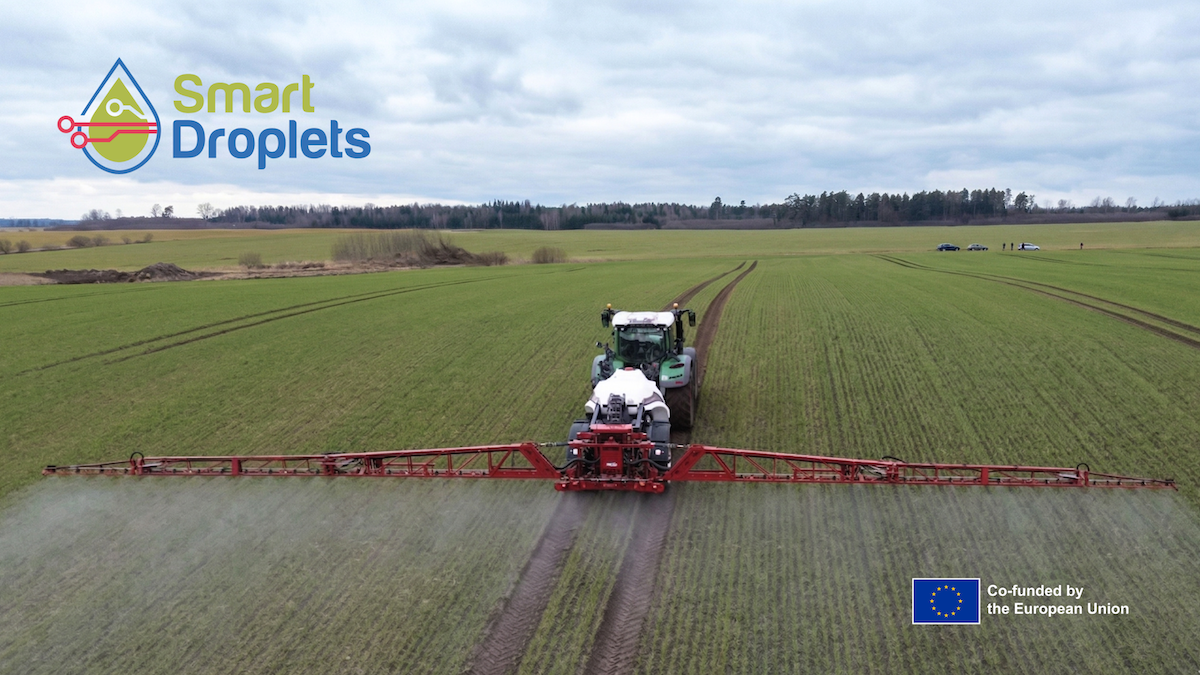
The Smart Droplets system was validated through pilot demonstrations in apple orchards in Girona, Spain, and winter wheat fields in Lithuania, where the integrated platform performed core agronomic operations such as pesticide spraying, herbicide spraying, and fertilisation using autonomous tractors and intelligent decision-support tools. These pilots assessed the performance of the full hardware-software ecosystem, including the interaction between the Digital Platform, Digital Twin models, AI-driven analytics, and robotic field operations.
From data to action: A fully integrated smart farming system
Smart Droplets developed an integrated system that enables targeted, site-specific crop protection. The system integrates:
- A Digital Platform that collects and manages real-time data from sensors, weather services, and field observations
- Digital Twin crop models that simulate crop growth, disease development, and treatment outcomes
- AI decision-support tools that generate recommendations for pesticide, herbicide, fertiliser, and water application
- Autonomous tractors and robotic navigation systems that execute field operations
- A Direct Injection System (DIS) enabling real-time chemical dosing and variable-rate spraying
This architecture enables a closed-loop decision system, where field data are continuously analysed and translated into precise application commands for autonomous machinery.
In the Spanish orchard pilot, the system successfully supported disease management for apple scab, a major fungal disease in European orchards, while in the Lithuanian pilot, the AI-assisted system generated nitrogen fertilisation recommendations aligned with expert agronomic advice.
Environmental and economic results from field pilots
The Smart Droplets pilots also assessed the economic feasibility of precision spraying technologies.
In the Spanish apple orchard pilot, the reduction of pesticide, fertiliser, and water inputs generated annual savings of €3,468 for the 0.64-hectare demonstration area, equivalent to approximately €5,419 per hectare per year. The largest economic benefits were linked to reduced water consumption, followed by savings in pesticides and fertilisers.
In the Lithuanian winter wheat pilot, the system generated annual economic benefits, primarily through reduced herbicide use and lower operational costs. While economic gains are smaller in lower-value cereal crops, modelling indicates that precision spraying technologies become increasingly cost-efficient at larger farm scales.
A break-even analysis conducted as part of the project shows that adoption thresholds vary significantly by crop type. The system becomes economically viable in apple orchards from approximately 1.7 hectares, while cereal production systems require larger operational scales of around 350 hectares to recover investment costs.
Supporting Europe’s sustainable agriculture goals
The innovations demonstrated by Smart Droplets directly address key policy priorities in the European Union, including the Farm to Fork Strategy, which aims to significantly reduce the use and risk of chemical pesticides while maintaining food production.
By enabling site-specific crop protection and nutrient management, the Smart Droplets system reduces unnecessary chemical applications, lowers water consumption, and improves worker safety while helping farms address labour shortages and rising input costs.
Voices from the ecosystem
The broader agricultural innovation ecosystem has recognised the importance of initiatives like Smart Droplets in accelerating Europe’s digital transformation in farming. Ioannis Amarantidis, Senior Project Manager at DigiAgriFood EDIH, noted that “the Smart Droplets project perfectly embodies the ambitions of the Digital Europe Programme, bringing advanced AI, autonomous systems, and data-driven decision-making directly to the field. DigiAgriFood sees this kind of innovation as foundational to building a competitive, sustainable, and digitally empowered European agrifood sector.”
Collaboration across research initiatives is also strengthening the impact of such technologies. “Smart Droplets is advancing precision crop protection through autonomous tractors, Direct Injection Systems, and AI-driven decision tools. By enabling targeted applications, the project reduces pesticide use, protects farmer safety, and minimizes environmental impact,” commented Christina Markou, Agricultural Engineer and Researcher at the Agricultural University of Athens and Work Package Leader in the STELLA project. “As another Horizon EU project, STELLA provides the ‘intelligence’ layer for this transition. By using a combination of remote and proximal data for early warning and disease detection, STELLA’s Pest Surveillance System complements the precision of Smart Droplets. Together, these systems can address the urgent challenges of labor shortages and rising costs, bridging the gap between high-tech farming and the EU’s ecological goals,” she added.
From Research to Real-World Adoption
A key objective of Smart Droplets was to ensure that advanced digital technologies could move beyond research prototypes and operate effectively in real agricultural environments. By validating the system in commercial farms across different crops and climatic conditions, the project demonstrated that artificial intelligence, digital twins, and autonomous machinery can function as a coordinated crop care system that reduces chemical inputs while maintaining agronomic performance.
The results provide strong evidence that precision spraying technologies can support farmers in managing rising input costs, labour shortages, and increasing environmental requirements. With measurable reductions in pesticide, fertiliser, and water use demonstrated during field trials, Smart Droplets offers a scalable pathway for the wider adoption of data-driven farming practices across Europe.
About Smart Droplets
Smart Droplets is a research and innovation project focused on developing advanced precision agriculture technologies to improve efficiency, reduce resource use, and support the transition towards more sustainable farming systems.
Developed by a multidisciplinary consortium of research institutions, technology developers, agricultural organisations, and innovation hubs, the project illustrates how collaboration between agronomists, robotics engineers, AI specialists, and farmers can accelerate the transition toward smarter and more sustainable crop management.
For more information, visit: https://smartdroplets.eu
Smart Droplets at a glance – Key facts and figures | |
Instrument | Horizon Europe |
Budget | EUR 3.175.475,25 |
Duration | 3,5 years (2022 – 2026) |
Consortium | Nine partners from six countries |
Project Coordinator | Spyros Fountas – Agricultural University of Athens (AUA) sfountas@aua.gr |
Contact Point | Grigoris Chatzikostas, reframe.food, L. Sofou 20, 57001, Thermi, Thessaloniki, Greece |

This project has received funding from the European Union. The views and opinions expressed are those of the authors and do not necessarily reflect those of the European Union or the granting of authority.