











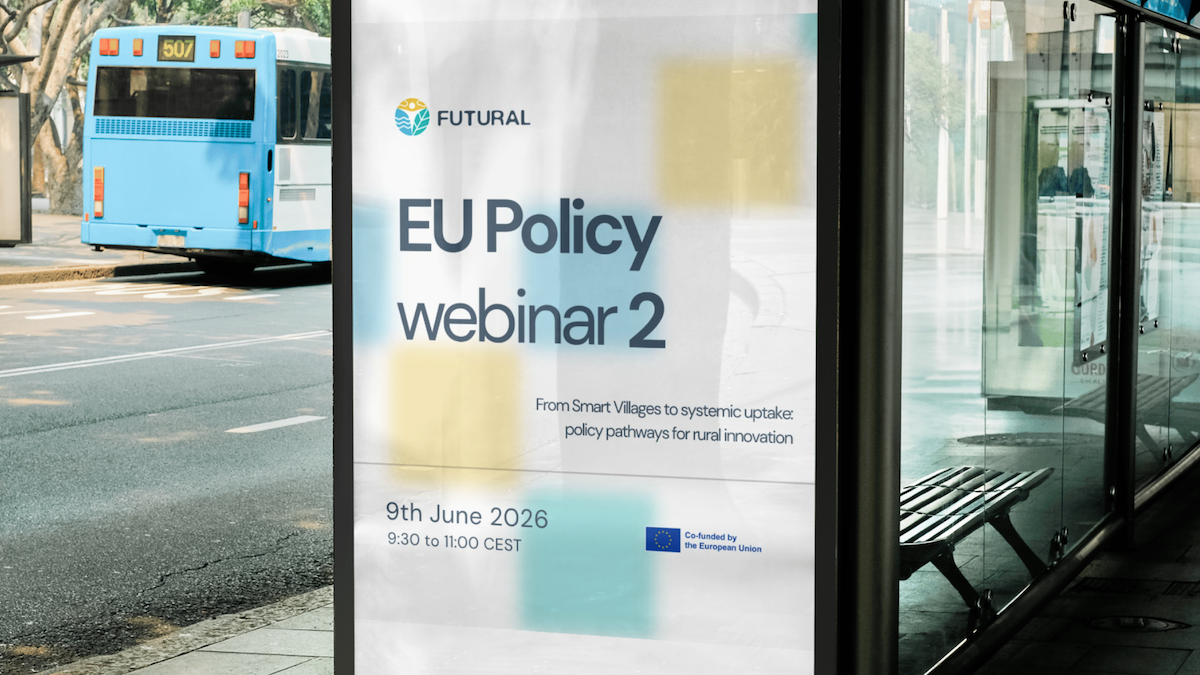
From Smart Villages to systemic uptake: policy pathways for rural innovation
The FUTURAL project, funded by Horizon Europe, organizes the 2nd EU Rural Innovation Forum (EU-RIF) online session on 9th of June 2026.
Titled “From Smart Villages to systemic uptake: policy pathways for rural innovation”, the webinar will explore how Smart Villages and community-led innovation approaches can move beyond local experimentation and become part of wider policy and governance frameworks for rural development.
Building on FUTURAL’s practical experience and the knowledge generated by its partners, the session will focus on the policy, governance and ecosystem conditions needed to support the uptake, scaling and transferability of rural innovation across different territories.
The event will bring together FUTURAL partners, sister projects, policy stakeholders and EU-level actors to exchange experiences, identify key challenges and enabling factors, and contribute to policy recommendations supporting smart rurality in the context of post-2027 EU programming debates.
Participation is open to anyone interested in rural innovation, Smart Villages and the future of rural development, and registration is available at: https://tinyurl.com/mt8sapfk
Who can attend?
The online session forum convenes a wide rural innovation ecosystem, including policymakers and implementers, rural innovation networks, EU-funded R&I projects, organisations, entrepreneurs, and community representatives, to exchange expertise, share policy insights, and explore pathways for scaling smart community-led innovation
Why participate in the 2nd online session?
This FUTURAL EU-RIF 2 online session aims to:
- Contribute evidence-based insights to FUTURAL policy recommendationsand strengthen synergies across EU rural innovation initiatives.
- Present and discuss key insights emerging from the discussions around smart rurality, including challenges, enabling conditions and policy gaps identified across Smart Villages and rural innovation practices.
- Identify key policy and governance factorsenabling the uptake of rural innovation in different territorial contexts.
- Exchange experiences with sister projectson policy learning, scaling pathways and interoperability opportunities.
- Contribute to the validation of governance and policy proposals, including aspects related to scaling, funding and cross-project policy instruments.
More information for the 2nd policy webinar
More information about the 2nd EU Rural Innovation Forum online session is available on the FUTURAL website: https://futural-project.eu/futural-2nd-policy-webinar/
Check the agenda here!
To stay informed about project’s events, news and updates, follow FUTURAL on social media:
- LinkedIn: FUTURAL Project
- Facebook: Futural project
- X: @FUTURALproject
About FUTURAL
FUTURAL is a project launched in June 2023 and funded by Horizon Europe aiming to empower rural communities through prototyping, testing, piloting, and demonstrating community-led social, technological and business innovations, through co-creation in six (6) Multi-Actor Pilots (MAPs) across the EU, varying in geographical and socio-cultural contexts. For this, a set of eight (8) digital Smart Solutions (SS) will be developed and deployed, addressing key societal and environmental rural challenges relating to five (5) Smart Solution domains, namely: 1. Circular Bioeconomy, Biodiversity and Ecosystem Management, 2. Resilience to Shocks, 3. Citizen Engagement and Quality of Life, 4. Lifelong Education and Training, and 5. Climate Adaptation and Mitigation, covering a wide range of relevant challenges faced by rural communities across the EU.
Project Coordinator
| Prof. Spyros Fountas Agricultural University of Athens 75 Iera Odos Str. 11855, Athens, Greece |
Project Communication
| Natassa Koufaki reframe.food L.SOFOU 20, 57001 Thermi, Thessaloniki, Greece |

Funded by the European Union. Views and opinions expressed are, however those of the author(s) only and do not necessarily reflect those of the European Union or European Research Executive Agency. Neither the European Union nor the granting authority can be held responsible for them.