






- The European project CATCO2NVERS demonstrates innovative pathways to transform CO2 emissions into high-value chemicals for use in several industry applications from cosmetics to green fuels
- The initiative has worked on cutting-edge catalytic processes — including electrocatalysis, biocatalysis, and thermocatalysis—to create sustainable feedstocks for green chemistry applications
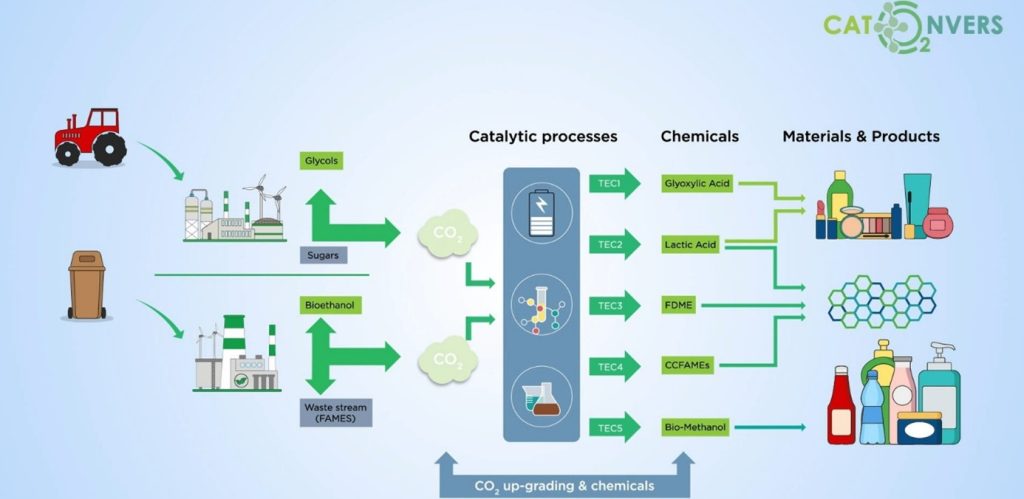
Madrid (Spain), December 10th, 2024 – The CATCO2NVERS project has achieved significant results in developing five novel CO₂ conversion technologies, each focused on converting carbon emissions into valuable chemicals and materials that support various industrial applications. From cosmetics to green fuels, these advancements mark a step forward in the sustainable transformation of carbon dioxide into eco-friendly products. Each of these technologies is designed not only to reduce emissions but also to establish CO₂ as a reliable feedstock in green chemistry.
Technology 1: Electrocatalytic Conversion of CO₂ to Glyoxylic
Acid Leading the charge in electrocatalytic innovation, Avantium has successfully developed a two-step electrochemical process that converts CO₂ into glyoxylic acid, an important component for the cosmetics sector. This process begins with the conversion of CO₂ into oxalic acid in a non-aqueous medium, followed by a reduction step to produce glyoxylic acid in an aqueous medium. Working with sustainable, nontoxic electrode materials, this approach bypasses conventional lead-based catalysts, enhancing both the environmental and operational efficiency of the process. The University of Twente has further refined the process by purifying the glyoxylic acid to meet the stringent purity standards required for cosmetic applications. The next project phase will focus on testing this technology in electrochemical demonstration units, providing a scalable model for CO₂-to-glyoxylic acid conversion.
Technology 2: Biocatalytic Conversion of CO₂ to Lactic Acid
Within the scope of CATCO2NVERS, researchers from Wageningen University & Research, in collaboration with Johnson Matthey, have harnessed biocatalysis to convert CO₂ emissions and bio-ethanol from biobased industries into lactic acid, a key ingredient in both cosmetics and biodegradable plastics. By employing newly identified, highly efficient enzymes, the team has successfully demonstrated an enzymatic pathway to lactic acid, achieving production from gas mixtures simulating CO₂-rich streams from industrial partners. This process not only offers an eco-friendly alternative to traditional lactic acid production but also advances the knowledge of enzymatic CO₂ utilization for future applications in green chemistry.
Technology 3: Chemical Conversion of CO₂ to FDME
FDME (furandicarboxylic acid methyl ester), a sustainable chemical alternative with applications in biobased plastics, has also been a key focus for CATCO2NVERS researchers. The team achieved two significant milestones: producing high-purity FDME through a solvent-free two-stage process using a single copper catalyst and developing catalysts via mechanochemical polymerization—a low-energy method. This innovative approach to FDME production offers both environmental and economic advantages, as the catalysts are highly stable and can be reused multiple times without loss of performance. These advancements underscore the potential for FDME as a sustainable alternative in polymer production, minimizing reliance on petroleum-based materials.
Technology 4: Conversion of CO₂ to Cyclic Carbonates (CCFAMEs)
Another notable achievement is that FUNDITEC has pioneered an efficient method for converting vegetable oils, such as soybean oil, into cyclic carbonates through a twostep process. By using metal-complex catalysts derived from porous organic polymers, this method achieves high efficiency (over 98% yield) and selectivity (97%) in converting nature-derived epoxides from fatty acids. The innovative “one-pot” approach combines oxidation and carbonation steps, resulting in a total yield of 60% for cyclic carbonates from vegetable oil. This sustainable methodology not only highlights the versatility of plant-based feedstocks in chemical manufacturing but also demonstrates the project’s commitment to green chemistry practices.
Technology 5: Catalytic Conversion of CO₂ to Methanol
Finally, the CATCO2NVERS project has achieved promising results in CO₂-to-methanol conversion, developing a high-performance, multi-metal catalyst embedded on an aluminium microfibrous network. This system demonstrates efficient CO₂ conversion (6.4%) with high methanol selectivity (83%), operating at pressures up to 10 bar, significantly lower than traditional processes. The catalyst’s performance is further optimized by a recirculation system that recaptures unconverted CO₂, enhancing the overall conversion efficiency. This technology presents a potential pathway for renewable methanol production, contributing to greener fuel alternatives.
Towards a Greener Future
With the successful development of these five technologies, the CATCO2NVERS project underscores the feasibility of transforming CO₂ from a waste product into a valuable resource, opening up new possibilities for sustainable manufacturing across sectors. By leveraging innovative catalytic and biocatalytic pathways, the project partners have set a strong foundation for future industrial-scale CO₂ conversion technologies, supporting the EU’s ambitious targets for carbon neutrality and sustainable economic growth.
About CATCO2NVERS
Coordinated by the Foundation for Development and Technological Innovation (FUNDITEC), CATCO2NVERS is formed by Avantium Chemicals BV, CARTIF, CSIC, DAN*NA Artificial Nature, EVYAP, University of Twente, Hysytech, Nova-Institute, Johnson Matthey, PERSEO Biotechnology, Sustainable Innovations and Wageningen Food & Biobased Research.
The project has received €6.6 million funding from the European Union’s Horizon 2020 research and innovation programme under grant agreement No 101000580.
Contact
Dulce Muñoz Subtil PhD | Technical Coordinator, FUNDITEC
Pablo Morales Moya | Communications Manager, Sustainable Innovations
info@CATCO2NVERS.eu