





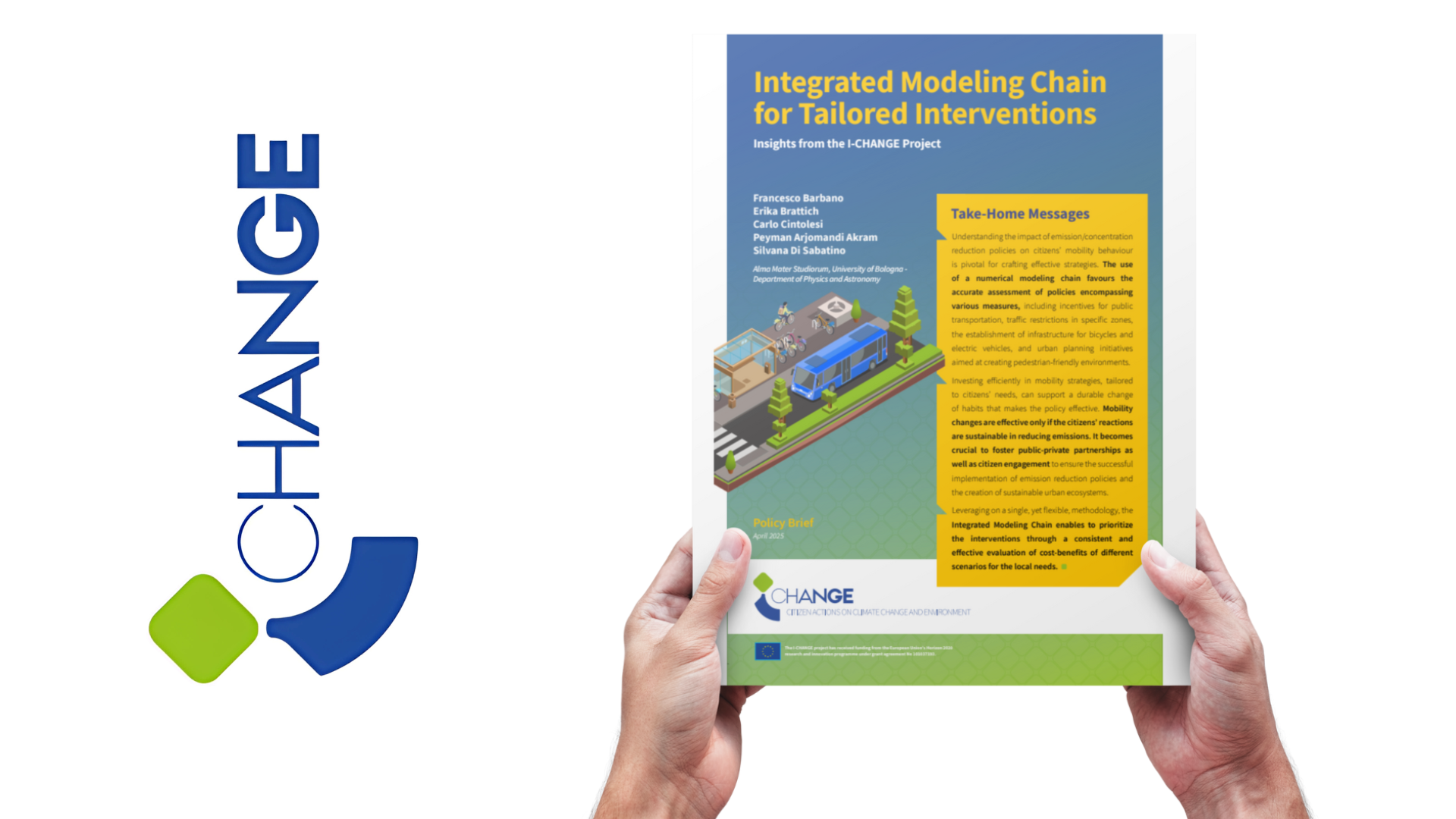
The I-CHANGE project releases its first policy brief, highlighting the critical link between air pollution and climate forcer mitigation strategies and citizens’ mobility behaviour in the context of sustainable urban development.
Titled “Integrated Modeling Chain for Tailored Interventions”, the policy brief presents key findings from research conducted within the I-CHANGE Living Labs in Bologna, Dublin, and Hasselt. The brief advocates for a holistic, data-driven approach to designing and evaluating mobility policies that aim to reduce CO₂ emissions, Greenhouse Gases (GHGs), Short-Lived Climate Forcers, and Air Pollutants.
At the heart of the brief is the Integrated Modeling Chain, a flexible and validated methodology that allows cities to assess the effectiveness of different policy scenarios.
This policy brief aims to guide policy makers, urban planners, researchers, and local authorities in making informed decisions that align environmental ambition with social reality.
For more information or to download a copy, visit here.
About I-CHANGE
I-CHANGE – Individual Change of HAbits Needed for Green European transition – is a European Horizon 2020 project which runs for 3,5 years (Start date: 1 November 2021). The project aims to face the challenge of engaging and promoting the active participation of citizens for addressing climate change, sustainable development and environmental protection in the framework of the European Green Deal, the European Climate Pact and the European Biodiversity Strategy for 2030. The activities of I-CHANGE are strongly rooted in real society through interaction, co-development and cooperation with eight interactive Living Labs across Europe (Amsterdam, Barcelona, Bologna, Dublin, Genoa, and Hasselt), Israel and Burkina Faso.
To learn more about I-CHANGE, visit the website: https://ichange-project.eu/
And follow the social media channels:
- X: @ICHANGE_EU
- LinkedIn: linkedin.com/company/ichange-eu
- YouTube: youtube.com/channel
This project has received funding from the European Union’s Horizon 2020 research and innovation programme under grant agreement No 101037193.