









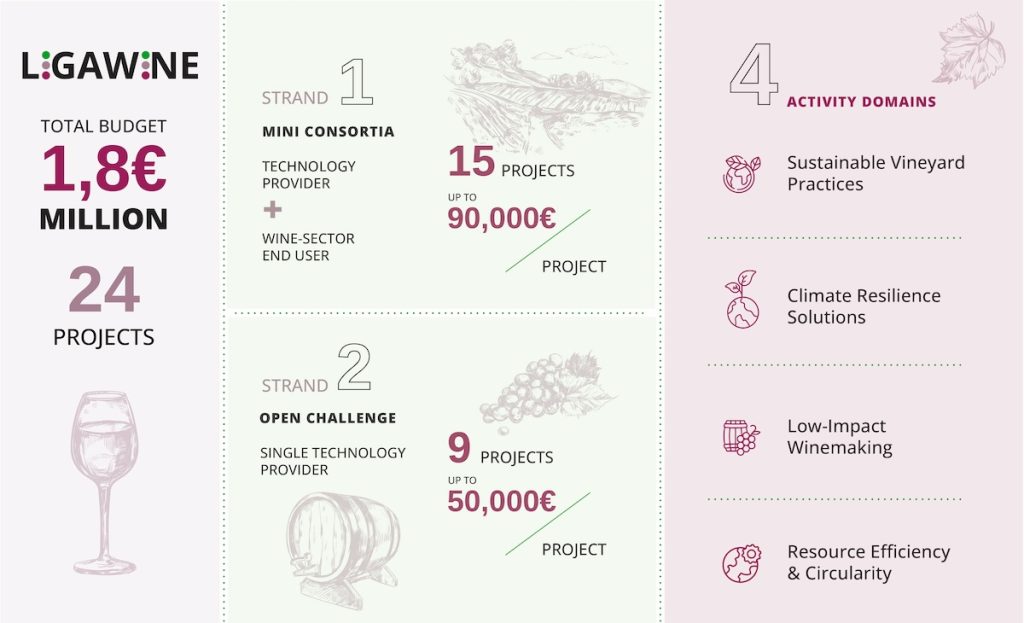
LIGAWINE has officially launched a €1.8 million Open Call to support the deployment, validation, and market uptake of sustainable, low-input, and digitally enabled innovations in vineyards and wineries across Europe.
The Open Call is designed and implemented by reframe.food through the opencalls.fund platform.
Funded by the European Union under the Interregional Innovation Investments Instrument (I3), the LIGAWINE Open Call aims to support practical, market-oriented innovation projects that address concrete operational challenges in viticulture and winemaking. Selected sub-projects are expected to validate mature solutions in real or relevant operational environments and demonstrate clear potential for uptake, replication, and contribution to sustainable wine production.
Two funding pathways available
Strand 1: Mini-Consortia (€1.35M)
The purpose of Strand 1 is to support the deployment and validation of a technological solution under real vineyard or winery conditions.
Supports 15 pilot projects led by:
- 1 technology provider, and
- 1 wine-sector end user (e.g., winery, wine producer)
Each project may receive up to €90,000, with a maximum of €60,000 per participating entity.
Strand 2: Open Challenges (€450,000)
Supports 9 single-applicant projects led by a technology provider addressing concrete challenges in viticulture or winemaking.
Each selected project may receive up to €50,000.
Key dates
- Open Call launch: 22 May 2026
- Submission deadline: 31 July 2026, 17:00 CET
- Evaluation: August–October 2026
- Project implementation: January 2027 – September 2028
Eligibility
Applicants must be SMEs established in eligible EU Member States or Overseas Countries and Territories covered by I3 rules. Eligible organisations include SME technology developers, digital solution providers, equipment manufacturers, wineries, wine cooperatives, and other wine-sector SMEs.
Each applicant may submit one proposal per Strand. LIGAWINE consortium members and affiliates are not eligible.
A minimum of 70% of the total budget will be allocated to SMEs established in EU Less Developed Regions, reinforcing cohesion and innovation deployment where it is most needed.
How to apply
Applications must be submitted via opencalls.fund Platform. Submissions received through any other channel will be automatically discarded.
Interested Applicants should:
- Read all of the Open Call kit and Applicant’s Guide
- Register on the platform
- Complete the online application
- Upload all required documents before the deadline
- Submit by 31 July 2026, 17:00 CET
English is the official language for the LIGAWINE Open Call. Applications submitted in any other language will not be evaluated. English is also the only official language throughout the whole execution of the LIGAWINE project. This means all requested contributions for the application (documents of the OC kit) must be submitted in English to be eligible.
Call for EvaluatorsLIGAWINE is also recruiting independent evaluators with experience in viticulture, winemaking, agri-tech, sustainability, digital agriculture, and SME innovation to evaluate proposals submitted to the Open Call. Evaluations will be conducted remotely between August and October 2026. Interested experts may apply by June 30 via: opencalls.fund |
Further information
Questions about the Call may be sent to: ligawine@opencalls.fund
Frequently Asked Questions (FAQ) will be updated on: opencalls.fund
About LIGAWINE
LIGAWINE is funded by the European Union under Grant Agreement No. 101228350. The project brings together partners from Europe’s leading wine-producing regions to strengthen sustainability, climate resilience, and competitiveness through the deployment of low-input technological solutions.
Note to editors:
At a glance – Key facts and figures
- Instrument: Interregional Innovation Investments Instrument (I3)- Financial support to third parties (FSTP)
- Total Open Call budget: 1,800,000 €
- Funding for each third party: up to 60,000 € (Strand 1), up to 50,000 € (Strand 2)
Disclaimer
Funded by the European Union. Views and opinions expressed are however those of the author(s) only and do not necessarily reflect those of the European Union or EISMEA. Neither the European Union nor the granting authority can be held responsible for them.