









The SMIDGE (Social Media Narratives: Addressing Extremism in Middle-Age) project, dedicated to addressing the growing concern of online extremism among middle-aged individuals, is pleased to announce significant advancements in its first two years of operation.
The SMIDGE Project is unique in its focus on the 45-65 age group, a demographic that is often overlooked in the study of online extremism. Middle-aged individuals, while not typically considered the primary target of extremist content, exhibit notable vulnerability to such narratives. Furthermore, they possess considerable influence as decision-makers, and their engagement with extremist content can have a profound impact on political discourse, democratic institutions, and societal norms.
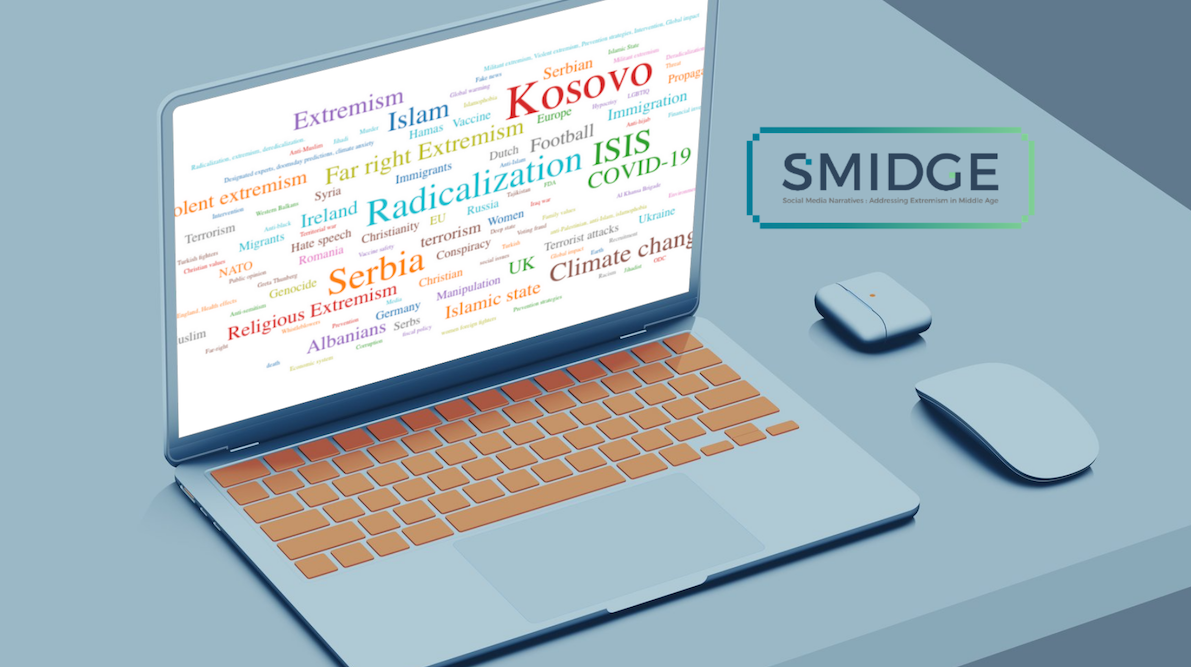
Through research and analysis, the SMIDGE Project is confronting the challenges posed by the proliferation of extremist content and misinformation across social media platforms. The project has conducted comprehensive horizon scanning, thematic reviews, and mapping exercises, which have resulted in the development of a detailed database of extremist narratives circulating online. This resource provides a foundation for the implementation of targeted interventions aimed at mitigating the impact of such content.
Launch of the SMIDGE Database Platform
The SMIDGE Project is proud to introduce its new database platform, a crucial tool for researchers, policymakers, and stakeholders working to combat online extremism. This platform offers an in-depth analysis of extremist narratives circulating on major social media platforms, including YouTube, Facebook, Instagram, TikTok, and Twitter. It categorizes content promoting far-right, religious, anti-vaccination, and conspiracy-based ideologies, ranging from militant messaging to misinformation. This platform provides vital data for evidence-based policy development and offers valuable insights into the evolving trends of digital extremism. Additionally, the platform enables researchers to report extremist content, further enriching the resource with real-time data.
Key Progress Reports and Research Findings
- Social Network and Text Analysis: The SMIDGE progress report on social network analysis examines the propagation of harmful content on social media, with a particular focus on disinformation and conspiracy theories related to online radicalization. This report draws on data from platforms such as the Daily Mail forum, Telegram, and YouTube to understand how extremist content influences public opinion and shapes societal discourse.
- Data Scraping of Extremist Content: The research on data scraping of extremist content is closely aligned with other work within the SMIDGE framework. This report contributes to the broader task of mapping prevalent conspiracy theories, misinformation, and extremist narratives, helping to provide a comprehensive understanding of the digital landscape.
- Online Survey Findings: SMIDGE has also conducted an online survey to investigate the factors influencing middle-aged individuals’ engagement with extremist media. The survey explores how demographic, social, personality, and cognitive factors shape their susceptibility to extremist narratives and their ability to critically evaluate media content.
In addition to its research initiatives, SMIDGE has a bi-monthly podcast series that delves into critical issues surrounding online extremism.
Smidge organised four webinars focused on examining extremist narratives and their impact on adults aged 45–65. These sessions addressed issues such as far-right and religious radicalisation, radicalisation within digital gaming spaces, and the spread of disinformation. Experts from journalism, academia, and civil society discussed how ideology, conspiracy theories, and manipulated information converge to radicalize middle-aged individuals.
The SMIDGE Project, funded by the European Union’s Horizon Research and Innovation Programme under grant agreement No. 101095290, started in March 2023 and is scheduled to run through February 2026.
As the SMIDGE Project enters its third year, it remains committed to making meaningful contributions to the fight against online extremism, particularly in the context of middle-aged individuals, and to fostering a safer, more informed digital environment.
The Smidge project will soon unveil its anticipated outputs, including a MOOC platform, a documentary, and counter-narratives.
For more information about the SMIDGE project and its activities, please visit www.smidgeproject.eu and follow @SmidgeProject on X, LinkedIn, Bluesky, and Youtube.
Media Contact: Klea Jaho, Communication Manager, Inclusive Europe, k.jaho@inclusiveeuropa.eu