










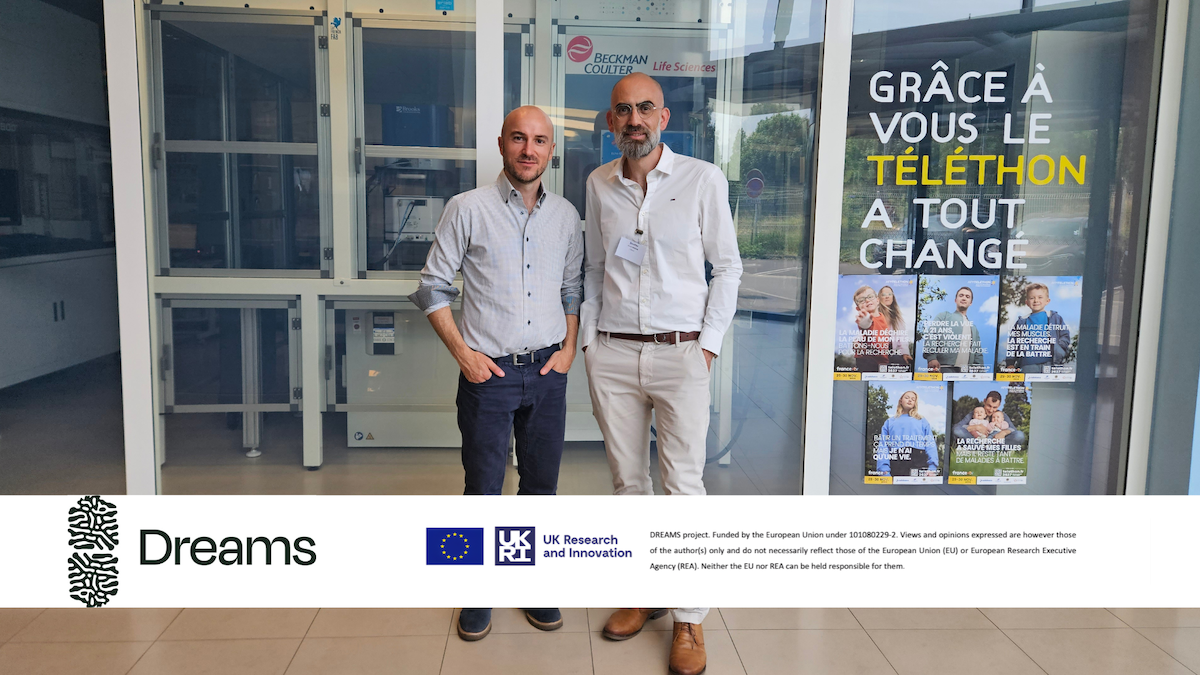
The DREAMS consortium is pleased to announce that University College London (UCL) has officially joined the project, strengthening its scientific and clinical expertise in neuromuscular disorders, stem-cell research, and data-driven discovery.
The European research project DREAMS has taken a major step forward with the incorporation of University College London (UCL), one of the world’s leading centres in biomedical research and regenerative medicine. UCL’s entry into the consortium strengthens the scientific, clinical and experimental foundation of a project that aims to fast-track new therapies for rare neuromuscular diseases affecting thousands of patients worldwide.
Rare neuromuscular disorders (NMDs) remain among the most underserved areas in medicine, with very few approved therapies and long, uncertain diagnostic and treatment pathways. DREAMS, funded under the Horizon Europe programme, tackles this challenge by combining AI-based drug discovery, patient-derived iPSC skeletal muscle models, and advanced phenotypic screening to identify and validate promising therapeutic candidates.
With UCL joining the consortium, DREAMS reinforces one of its most critical pillars: the generation and functional analysis of high-quality human cellular models. UCL brings internationally recognised expertise in neuromuscular disease biology, stem-cell engineering, and translational research—expertise that directly enhances three core work packages of the project.
A strategic contribution to the scientific engine of DREAMS
As part of its role in DREAMS, UCL contributes to:
- WP1 – Biomarkers and proteomic signatures in 5 rare neuromuscular diseases. UCL supports the identification of dysregulated genes and proteins and contributes to biomarker validation using advanced human muscle cell systems.
- WP3 – New iPSC lines and disease models. UCL leads the generation of new patient-derived iPSC lines, their differentiation into myotubes, and the evaluation of disease-specific and drug-response phenotypes, an essential step for expanding DREAMS’ therapeutic pipeline.
- WP4 – Validation of AI-identified drug candidates. UCL performs in-vitro efficacy assays to test compounds predicted by DREAMS’ AI tools, bridging the gap between computational discovery and preclinical validation.
What UCL brings to the project
- Expertise in generating high-quality patient-derived iPSC lines for additional neuromuscular diseases, expanding the diversity and robustness of DREAMS’ experimental models.
- Advanced muscle differentiation and cellular modelling capabilities, enabling detailed analysis of disease mechanisms and biomarker validation.
- Specialised assays to test drug efficacy and mechanisms of action in relevant human skeletal muscle models, supporting downstream preclinical studies.
- Deep clinical and scientific knowledge of neuromuscular disorders, strengthening DREAMS’ capacity to identify shared disease mechanisms and accelerate translational impact.
A decisive boost for patients with rare neuromuscular diseases
“We are delighted that UCL is joining the DREAMS consortium to advance research into rare neuromuscular disorders. This collaboration allows us to combine UCL’s expertise in stem cell modelling, disease phenotyping, and advanced therapies with the consortium’s collective strengths. By harnessing our strategic partnerships with the Francis Crick Institute and the NIHR Great Ormond Street Hospital Biomedical Research Centre, we aim to accelerate the translation of cutting-edge science into meaningful therapies for patients.” Prof. Francesco Saverio Tedesco & Dr. Sara Benedetti, University College London
By enhancing DREAMS’ experimental capabilities and expanding its clinical insight, UCL strengthens the consortium’s mission: to accelerate safe, effective and patient-centred therapeutic development for rare neuromuscular diseases, a field where progress is urgently needed.
Media contact
Media Contact:
Beatriz Quintillá Zabal