




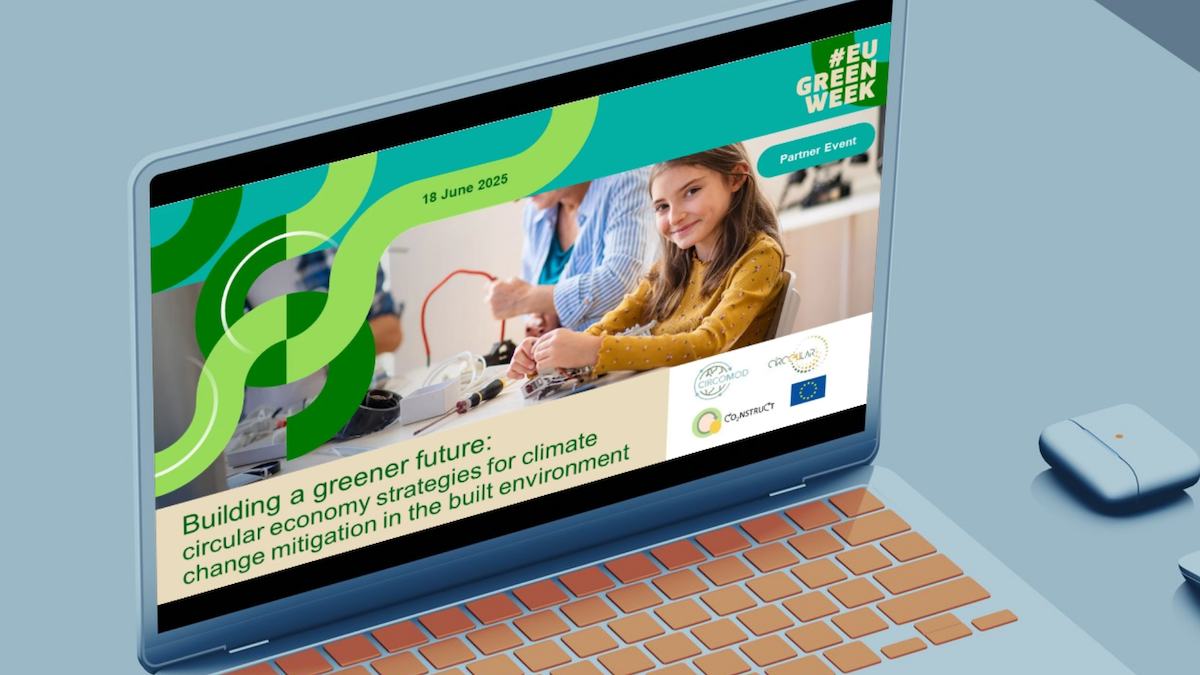
June 2025 – As the building sector continues to be a significant contributor to global resource consumption and greenhouse gas emissions, the need for sustainable and circular solutions has never been more urgent. In response, three Horizon Europe projects – CIRCOMOD, CircEUlar, and CO2NSTRUCT – are joining forces to host a dynamic webinar exploring how circular economy strategies can drive climate change mitigation into the built environment. The webinar will take place online on June 18th 2025, from 10.30am to 12.00 pm CEST.
The session will focus on policy frameworks, circular pathways, and consumer behaviour, highlighting good practices and research findings that support the transition to circularity. More specifically, we will explore:
- Circular pathways for the built environment
- Value chain approach to augment climate mitigation models with circular economy practices: The case of flat glass
- Smarter design and use of household appliances for a circular Europe
Participants will gain valuable insights into how circular economy principles can be effectively implemented across the building sector, addressing societal, business, and policy needs.
The event is particularly addressed to policymakers, industry professionals, researchers, and advocates of sustainable urban development.
Join us to be part of the conversation shaping a more sustainable future!
See the EU Green Week Event Page for more information.
About the projects
CircEUlar is a four-year (Starting date: 1 September 2022) European Research and Innovation Action project that develops new modelling approaches for analysing circularity from a systems perspective accounting for: dematerialisation and the transition to a service-based economy to limit material stock growth; lifetime extension of material stocks through repair, maintenance, reuse; waste treatment and material recycling. To learn more about CircEUlar, visit the website, and follow on BlueSky and LinkedIn
The CircEUlar Project has received funding from the Horizon Europe Research and Innovative Action Programme under Grant Agreement No. 101056810, the Swiss State Secretariat for Education, Research and Innovation (SERI), and by UK Research and Innovation UKRI.
Contact: circeular.secretariat@iiasa.ac.at
CO2NSTRUCT is an EU-funded research project that has set out to identify, test, and quantify circular economy impacts for climate mitigation modelling for six key carbon-intensive materials: cement, steel, brick, glass, wood, and insulation materials. We need extensive data on the impacts of the extraction of raw materials, logistics, transformation, and consumer industries covering the whole life cycle of these materials. To learn more about CO2NSTRUCT, visit the website, and follow on LinkedIn
CO2NSTRUCT has received funding from the European Union’s Horizon Europe research and innovation programme under grant agreement No. 101056862.
Contact: co2nstruct@sustain.dtu.dk
CIRCOMOD project is developing a new generation of advanced models and scenarios that will assess how Circular economy can reduce future GHGs and material use. The prominent teams of modelers have joined forces under CIRCOMOD, forming a unique cross-disciplinary family including industrial ecology and material flow modeling, process-oriented integrated assessment modeling, and macro-economic modeling. The project is funded by the European Union’s Horizon Europe programme. To learn more on CIRCOMOD, visit the website, and follow on LinkedIn.
CIRCOMOD project has received funding from the Horizon Europe Research and Innovation Action Programme under Grant Agreement No 101056868
Contact: Oreane Edelenbosch: o.y.edelenbosch@uu.nl or Detlef van Vuuren: Detlef.vanVuuren@pbl.nl or Asel Doranova: A.A.Doranova@tilburguniversity.edu